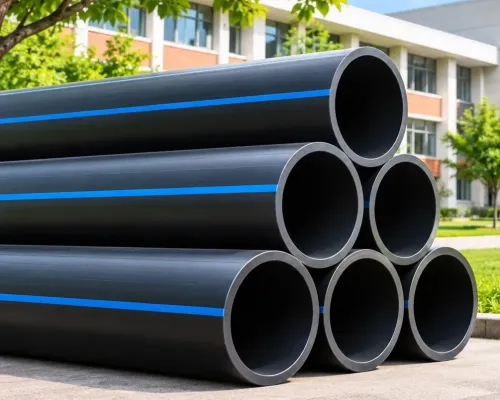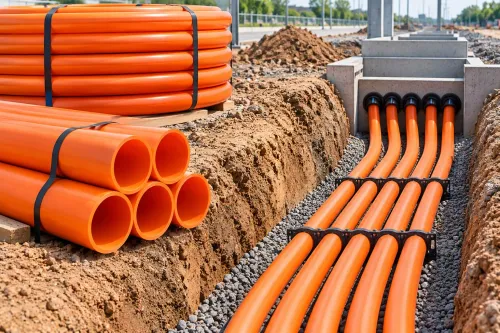
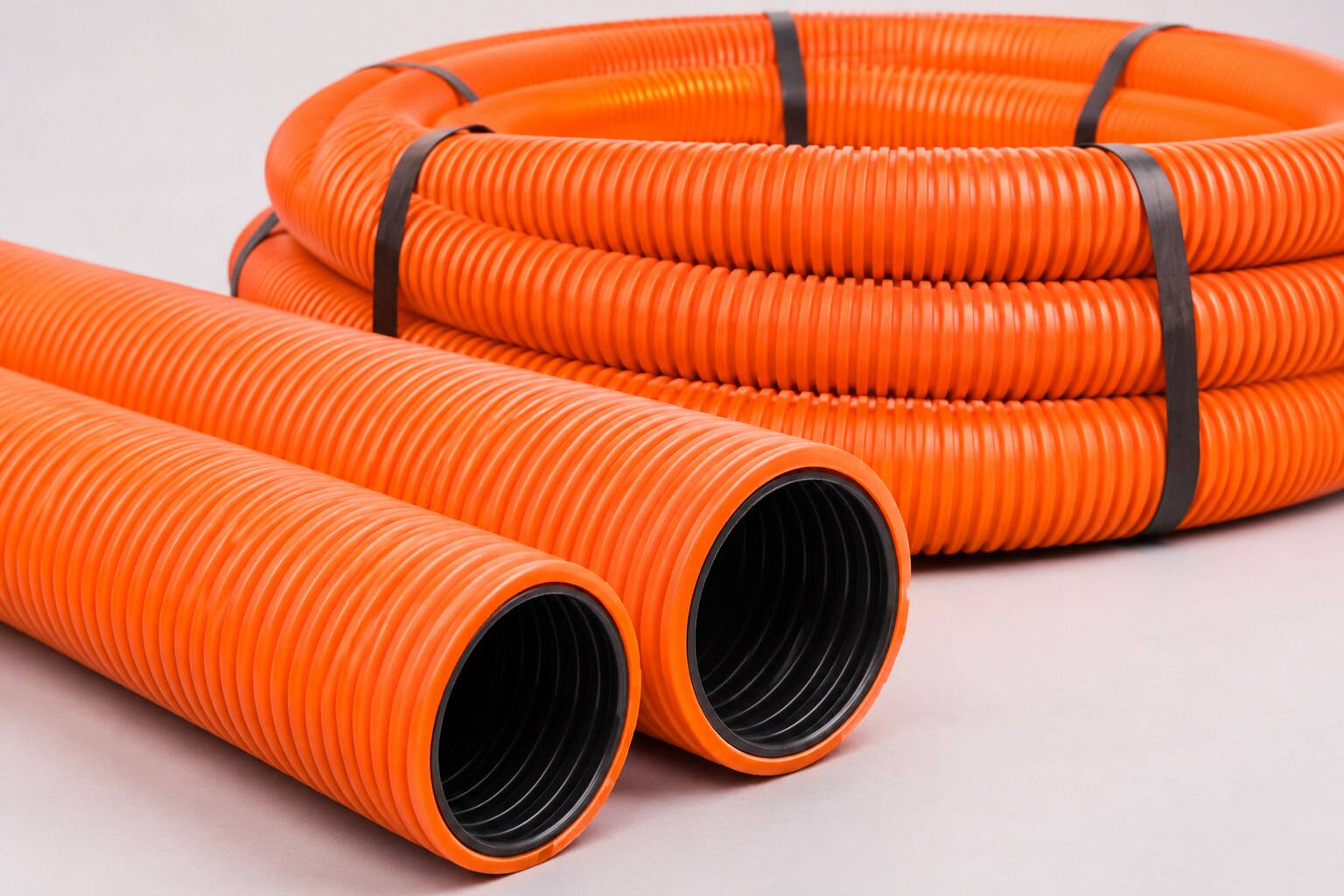
Choosing an underground feeder route near Nagpur requires more than comparing HDPE and concrete by material price. The correct choice depends on cable loading, road exposure, soil and groundwater, construction method, future capacity, authority requirements, and the evidence supplied at handover.
Key takeaways
- Use HDPE with engineered bedding, cover and controlled backfill.
- Choose concrete duct banks where fixed protection and load resistance dominate.
- Assess cable heat, pulling tension, bend radius and future capacity together.
- Require duct records, test results, as-built drawings and handover documents.
What is the structural difference between an HDPE duct and a concrete duct bank?
A single HDPE duct is a flexible, non-pressure conduit; a concrete duct bank is a rigid encasement that transfers external loads through its concrete mass. HDPE relies on bedding, side support, minimum cover and controlled backfill, while concrete provides fixed mechanical protection and alignment.
| Option | Physical system | Best fit |
|---|---|---|
| Single HDPE duct | One flexible conduit for one feeder | Adequate cover, controlled trench support and manageable excavation risk |
| Multi-duct HDPE bundle | Several conduits for power, control, telecom or spares | Long routes needing flexibility and future capacity |
| Reinforced concrete duct bank | Multiple conduits held at fixed spacing inside concrete | Concentrated traffic loads, shallow cover, excavation risk or mandated protection |
Select the system only after you know the feeder voltage, cable diameter, cable count, minimum cover, road-loading class, likely excavation risk, spare-duct requirement and future expansion. One duct is not equivalent to one bundle, and a shared trench is not automatically a shared duct bank.
Specify conduit dimensions and tolerances, crush and impact resistance, ring stiffness or an equivalent load criterion, allowable pulling tension, minimum bend radius, jointing method and cable compatibility. IS 4984 pressure-pipe marking alone does not prove electrical-conduit suitability.
In Nagpur, also assess black-cotton soil movement and waterlogged trenches: flexible HDPE accommodates movement only with engineered bedding and selected backfill, while concrete can crack or shift under differential ground movement.
How do open-cut and HDD installation compare on Nagpur routes?
Open-cut suits accessible corridors where excavation, utility clearance and reinstatement are manageable. HDD suits road crossings and congested utility corridors, but hard basalt can slow drilling, while black-cotton soil needs controlled support because seasonal movement affects both ducts and pits.
| Option | Ground and surface fit | Main controls |
|---|---|---|
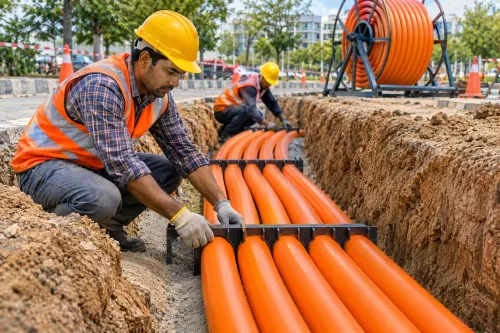
| Open-cut HDPE | Direct access, longer disruption | Selected bedding, side support, fusion or couplers, staged backfill, temporary flotation restraint and protected pits or transitions |
| HDD HDPE | Roads, traffic-sensitive routes and congested utilities | Bore geometry, minimum cover, entry and exit pits, bend radius, pullback force, bore stability, drilling-fluid control and utility locating |
| Concrete bank | Fixed multi-duct protection in open excavation | Trench, bedding, spacers, reinforcement or formwork, concrete placement, curing, warning tape, covers and reinstatement |
Monsoon runoff and groundwater can float an empty HDPE duct or wash out an uncured concrete bank. Use ballast, staged backfill, collars or other temporary restraint, and provide dewatering and pit protection.
Black-cotton soil demands selected backfill and geotechnical treatment; flexible HDPE accommodates movement better than a rigid bank, but does not cure an unstable trench.
HDD reduces road closure, not project control. Verify utilities by records and physical locating, maintain traffic protection, control drilling fluid, and survey pits, depths, bends and crossings for as-built records. HDPE’s long fused lengths reduce underground joints; rigid concrete banks do not follow a curved bore efficiently.
For electrical duct bank alternatives Nagpur projects, a hybrid route often fits best: HDD or HDPE long runs with concrete collars at crossings, shallow sections and pit approaches. Compare traffic management, reinstatement, curing and third-party damage—not duct price alone.
How do cable loading, heat, pulling and protection change the selection?
The feeder is safe only when the ampacity calculation matches its installed arrangement. Cable count, diameter, voltage, conductor losses, spacing, burial depth, soil thermal resistivity and surrounding material all affect heat removal.
Concrete encasement does not automatically increase current capacity; it can dissipate heat less effectively than favorable direct burial, so use the actual duct-bank and soil parameters.
Reserve capacity must be designed, not assumed. Check these items before approving the HDPE electrical duct or concrete Nagpur route:
- Separate power, control and telecom services according to the utility owner’s spacing rules; one trench does not mean one shared duct bank.
- Provide spare ducts for future feeders, with colour coding, route markers and surveyed duct numbers.
- Confirm the cable’s minimum bend radius, allowable pulling tension and sidewall pressure for every bend, chamber and transition.
- Use end bells, temporary caps and permanent end seals; joints, spare ducts and low points can admit water. Add drainage or a sump where the design requires it.
- Mandrel-test each duct and verify draw-rope continuity before cable pulling.
HDPE needs movement control during temperature changes. Do not tightly restrain hot duct during daytime installation; provide suitable slack, controlled backfill and chamber transitions so cooling contraction does not pull joints or shift terminations.
A concrete bank improves mechanical protection and may support fire separation, but it is not automatically watertight. HDPE is combustible and is not a fire barrier. Building, substation, transformer and fire-compartment crossings may require fire stopping, non-combustible encasement, separation or sealed penetrations.
A concrete Nagpur feeder route still needs those details designed as a complete assembly.
What should the project specification and handover documents require?
Require performance evidence, not a visual pass. An underground feeder duct comparison in Nagpur is incomplete until the specification proves that cables can be installed, identified and replaced without discovering ovality, debris, displaced joints or an undersized bend.
1. Specify the electrical duct’s outside diameter, wall tolerance, crush or ring-stiffness criterion, impact performance, allowable pulling tension, minimum bend radius, jointing method, draw-rope rating, colour or identification, cable compatibility and installation-temperature limits. State that IS 4984 marking alone does not qualify a water pipe as an electrical duct.
2. Make acceptance procedural: pass a correctly sized mandrel through every duct, then brush or swab it; verify draw-rope continuity and rating; record installed duct lengths and bend locations; seal duct ends; and inspect every chamber for debris, standing water, damaged joints and accessible rope ends. Control cable pulling tension and sidewall pressure.
3. For concrete banks, record duct spacing, spacers, reinforcement details, project-specified concrete grade, placement records and curing evidence. Require warning tape, covers and a surveyed bank position before backfilling.
4. Handover documents must show route coordinates, depths, duct numbers, spare-duct status, crossings, pits, joints, test results and as-built drawings. When assessing Tatiwar Agro Industries, request product data, batch identification, dimensional records, jointing instructions and test evidence for the actual electrical duct, not only a water-pipe standard.
This documentation prevents a route from passing inspection yet failing at cable pull or future maintenance.
Related products
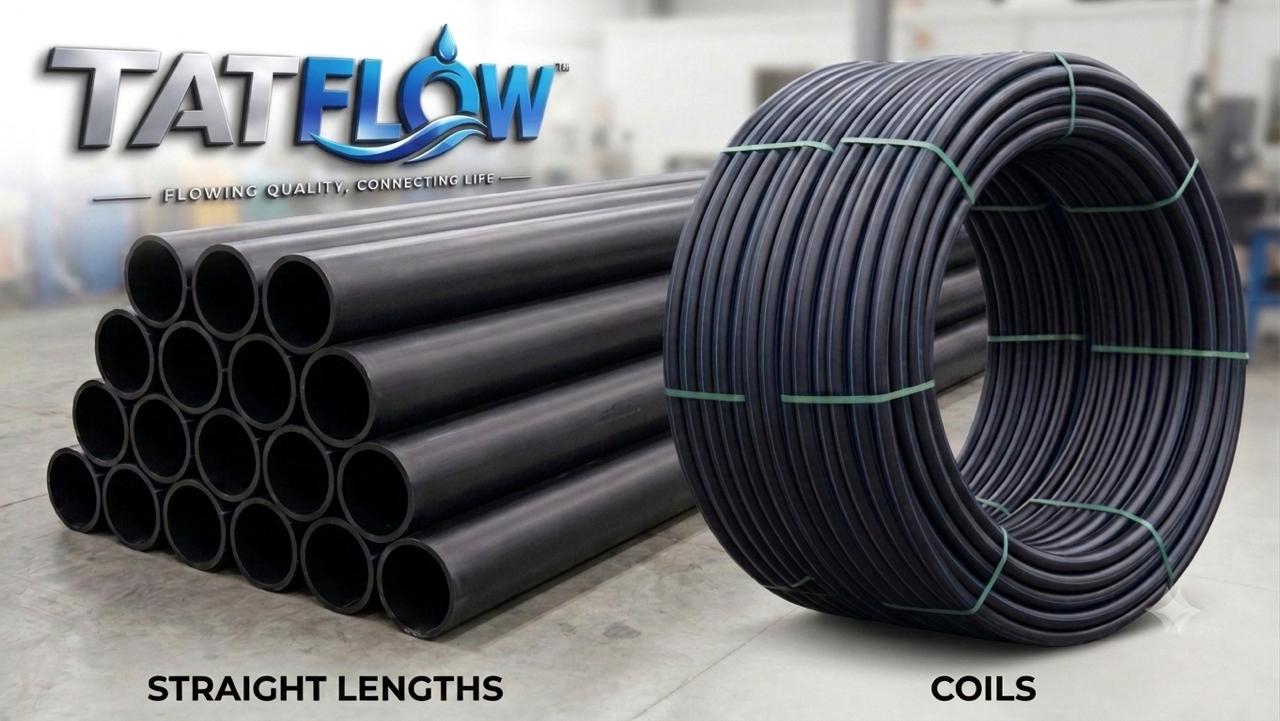 | TATFLOW HDPE Pipe for Electrical Ducting Solutions (HDD Application) TATFLOW HDPE Pipe for Electrical Ducting Solutions (HDD Application) TATFLOW HDPE Pipe for Electrical Ducting Solutions (HDD Application) Reliable HDPE Ducting for Modern Electrical Infrastructure TATFLOW HDPE Pipes... View product → |
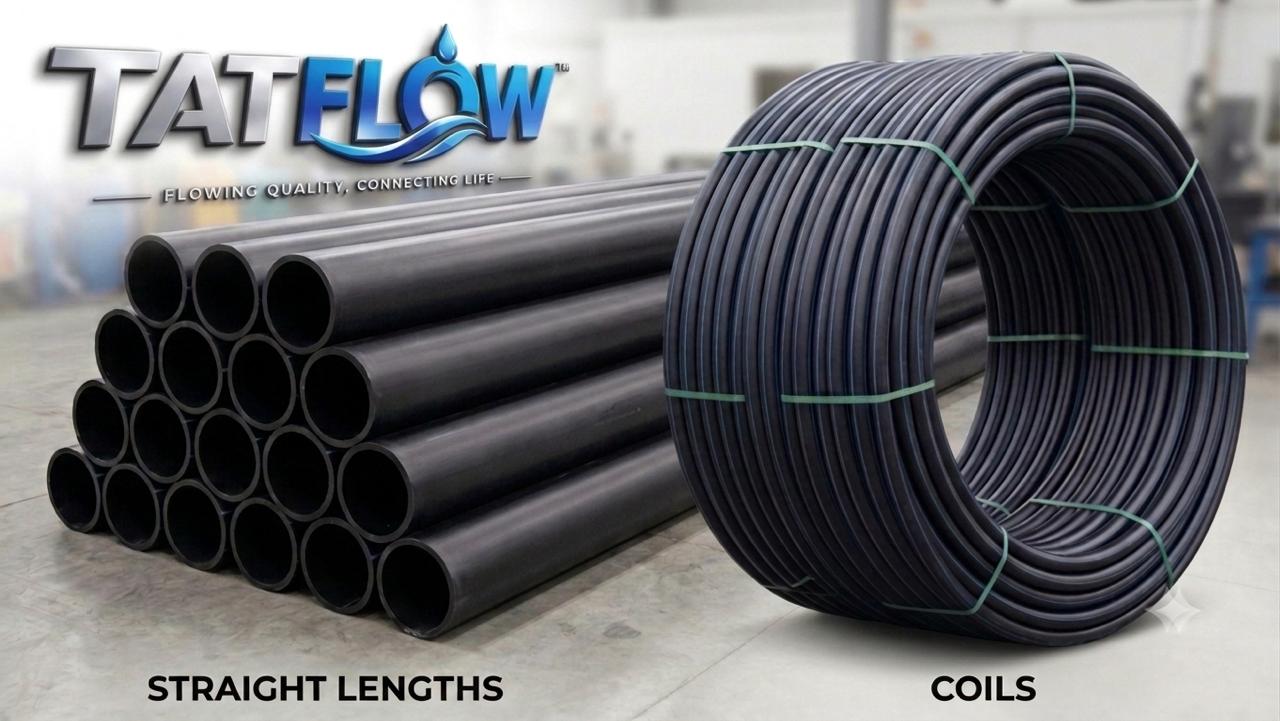 | HDPE DUCT Pipes for HDD Applications HDPE DUCT Pipes for HDD Applications Reliable HDPE Ducting for Modern Electrical Infrastructure TATFLOW HDPE Pipes for Electrical Ducting are designed to provide a reliable, durable and... View product → |
When is HDPE, concrete, or a hybrid route the better decision?
Choose standalone HDPE when the utility, consultant, road authority or railway authority accepts flexible conduit, controlled trench support and backfill, adequate cover, spare ducts, access chambers and manageable third-party excavation risk. For a Tatflow electrical duct versus concrete duct bank Nagpur decision, confirm those conditions in writing.
Require concrete encasement when the governing standard specifies it, or when shallow cover, concentrated traffic, repeated excavation, accidental impact, fixed multi-duct separation, fire protection or mechanical protection demands a rigid bank. Price the excavation, reinforcement or spacers, concrete placement, curing, traffic management and reinstatement—not just the ducts. Future cable replacement becomes harder after curing.
Compare HDPE’s jointing, mandrel testing, draw-rope continuity, flotation restraint, chambers and exposure to excavation damage. A flexible route is not low-cost if it lacks spare capacity or access points.
Use this checklist for electrical duct bank alternatives Nagpur:
- Approve standalone HDPE only after checking cover, road loading, soil support, cable pulling limits, bend radius and authority acceptance.
- Select concrete where protection risk exceeds the cost of excavation, placement, curing and difficult replacement.
- Use a hybrid: HDPE for long runs or HDD crossings, with concrete collars or encasement at road crossings, shallow sections, pit approaches and transitions.
- Include traffic-control, reinstatement, expected third-party damage, cable-replacement strategy and unused spare ducts in lifecycle cost.
Frequently asked questions
What is the structural difference between an HDPE duct and a concrete duct bank?
An HDPE duct is a flexible, non-pressure conduit that relies on bedding, side support, cover and controlled backfill. A concrete duct bank is a rigid encasement that transfers external loads through its concrete mass.
How do open-cut and HDD installation compare on Nagpur routes?
Open-cut installation exposes the trench for bedding, duct placement and backfill. HDD reduces surface disruption but requires a bore profile, entry and exit pits, pullback calculations, conduit buoyancy control and post-installation verification.
How do cable loading, heat, pulling and protection affect selection?
Compare cable fill, heat dissipation, pulling tension, sidewall pressure, bend radius, separation and required mechanical protection before selecting HDPE, concrete or a hybrid arrangement.
What should the project specification and handover documents require?
Specify duct size, material standard, SDR or wall thickness, bend limits, spacing, cover, bedding, warning systems, test methods and acceptance criteria. Require batch records, delivery inspections, route surveys, mandrel or proving results, draw-rope details, photographs and as-built drawings at handover.
When is HDPE, concrete or a hybrid route the better decision?
Use HDPE when low surface disruption, corrosion resistance and route flexibility matter. Use concrete where heavy external loads, fixed alignment or high mechanical protection control the design. Use a hybrid route where each condition changes along the alignment.
Related product
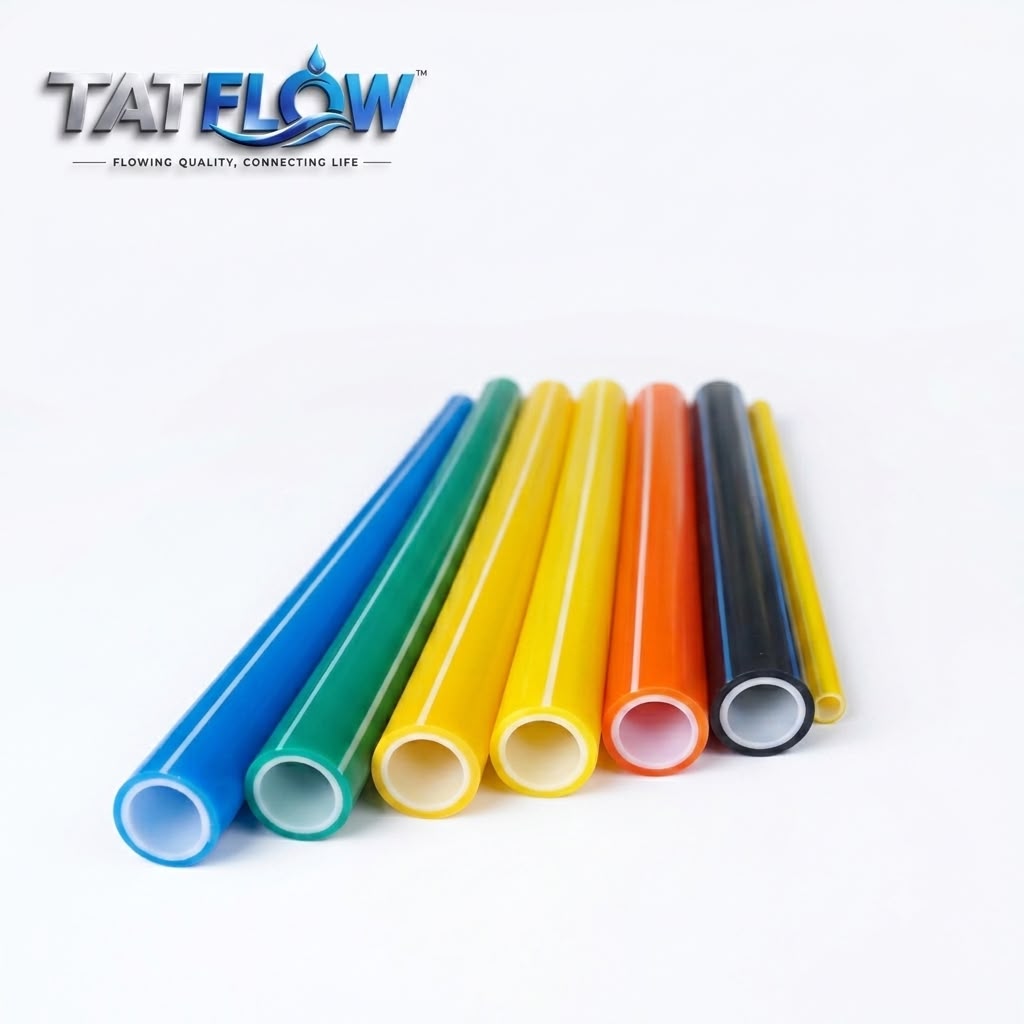 | PLB DUCT pipe for Railway Signal & Telecom Ducting TATFLOW PLB DUCT pipe for Railway Signal & Telecom Ducting TATFLOW PLB Duct Pipe is a high-quality ducting solution designed for the safe and efficient installation and protection of Railway Signal,... View product → |
Keywords