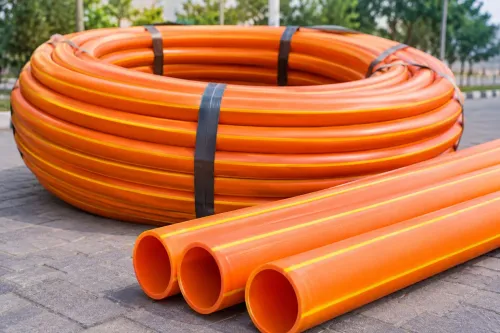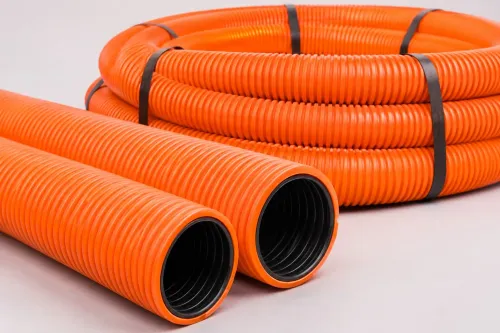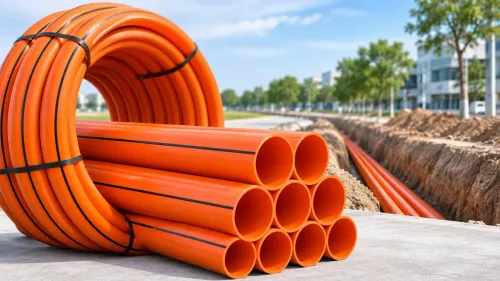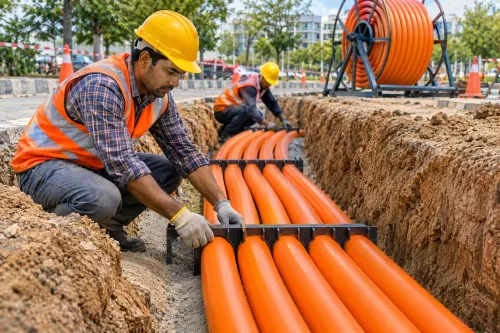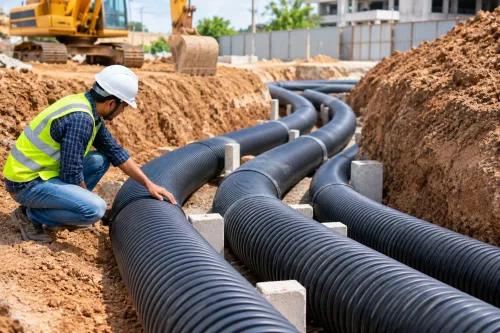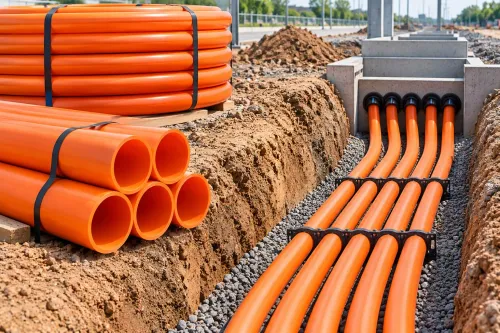
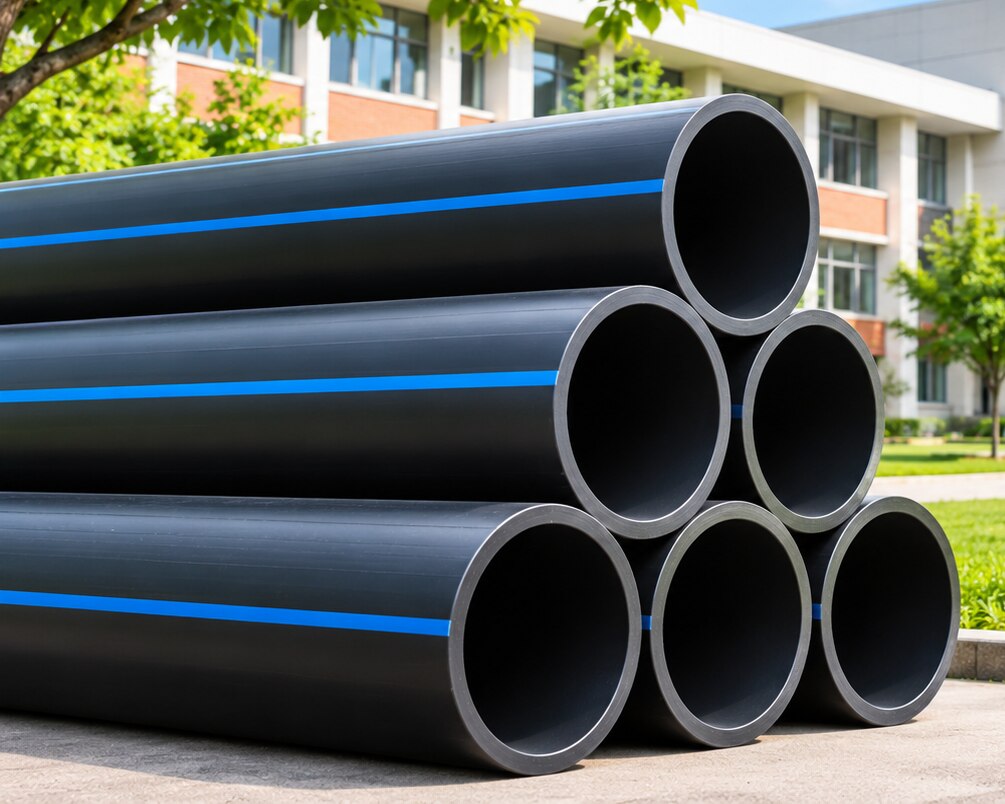
A campus network must move water reliably between the source, storage tanks, pump room, hostels, laboratories, hospitals, kitchens, irrigation zones and fire-water systems without creating dead legs or maintenance shutdowns. By the end, you will be able to plan the layout, calculate demand, specify the pipe and joining method, and control installation risks specific to Nagpur sites.
Key takeaways
- Use a looped main so critical buildings retain supply during isolation.
- Size pipes from peak demand, friction loss, velocity and available pressure.
- Specify PE grade, SDR, pressure rating, IS 4984 compliance and traceable test records.
- Control trench drainage, electrofusion or butt-fusion, backfill and pressure testing before commissioning.
How should you map an institutional campus water network?
1. Draw the route from the municipal or approved source connection to raw-water or treated-water storage, the pump room, and the campus ring main. Use a loop, or a selective loop around critical buildings, so a remote block receives water from the opposite direction when one section is isolated.
2. Divide the main into hydraulic isolation zones. Place valves at building branches, crossings, hydrants, tank-entry points, irrigation take-offs and other high-consequence locations, with chambers large enough for operation, drainage and maintenance. End branches close to the point of use to reduce dead legs.
3. Keep potable, recycled, raw and fire-water systems separate. Do not create an improvised bypass between them; cross-connection can contaminate drinking water and defeat fire-flow control. Put air-release or air/vacuum valves at high points and washouts at low points for filling, flushing and drain-down.
4. Detail every transition: HDPE to pumps, meters, valves, steel headers, tanks, wall penetrations and concrete structures needs a flange adaptor, backing ring, flexible or restrained coupling, and access for bolt inspection. Do not force a pipe through a rigid wall without a sleeve and sealed penetration.
5. For HDPE water pipes for institutional campuses in Nagpur, specify service, material, SDR, pressure class and IS 4984 where applicable. Remember that hdpe pipe for institutional water networks is pressure pipe, not cable ducting: duct internal diameter, pulling tension, crush resistance and bend radius do not prove hydraulic suitability.
That distinction protects hdpe water infrastructure for institutions.
How do you size a campus water-supply pipe and select PE grade?
Average daily consumption cannot size a campus water supply pipe. Model peak-hour demand, simultaneous hostel or housing use, toilet fixtures, kitchens, laboratories, hospitals, cooling systems, tank-refill time and future expansion. Check velocity, pump operating points, remote-building residual pressure, storage capacity and fire-flow scenarios where applicable.
- Build a hydraulic model for the ring main and every branch. Test normal peak demand, tank filling, one isolated section, pump trip and pump restart. Include surge and transient pressure; a pipe that passes steady-state pressure can fail when a valve closes or a pump stops.
- Select diameter from allowable head loss and velocity, not consumption alone. Confirm the smallest remote residual pressure, pump duty and refill duration. Reserve capacity for planned buildings, but do not oversize low-use branches that create stagnant water.
- Specify the service explicitly: potable, raw, recycled or fire water. “HDPE” alone is inadequate for a campus water supply pipe Nagpur project or other water pipe projects Nagpur; state material grade, outside diameter, SDR, PN rating and applicable standard, such as IS 4984 where applicable.
- Compare PE grades with the designer’s pressure and lifetime calculations. PE100 generally provides higher strength than PE80 or PE63 at the same dimensions, but temperature, surge and operating conditions require PN derating.
| PE100 designation | Approximate relationship at 20°C |
|---|---|
| SDR 11 / PN 16 | Thicker wall, higher pressure capacity |
| SDR 17 / PN 10 | Intermediate wall and rating |
| SDR 21 / PN 8 | Lower pressure service |
| SDR 26 / PN 6.3 | Thinner wall |
| SDR 33 / PN 5 | Thinnest listed wall |
SDR equals outside diameter divided approximately by wall thickness: higher SDR means less wall and lower capacity. This comparison helps specify HDPE pipe for institutional water networks without confusing a lightweight branch with a surge-exposed ring main.
What should the procurement specification and compliance file contain?
Compare bids against a named service schedule, not the label “HDPE.” Name IS 4984 where it applies and record outside diameter, material grade, SDR, nominal pressure or PN rating, service medium, and potable-water requirement. For HDPE water pipes for institutional campuses Nagpur, state the soil, traffic loading, and installation method.
| Field | Schedule entry | Acceptance check |
|---|---|---|
| Service | Potable, raw, recycled, or fire water | Matching pipe and fitting documents |
| Dimensions | Outside diameter, SDR, PN rating | Markings and certificates agree |
| Conditions | Soil, traffic, burial or HDD method | Contractor’s method statement is specific |
Require this receiving record for every delivery:
- Manufacturer name, batch or lot number, delivery quantity, dimensions, SDR marking, and pressure class
- Test certificates and conformity documents for pipes and fittings
- Material traceability from resin or compound to delivered batch
- Fitting compatibility, fusion procedure, operator qualification, joint records, and inspection results
- Delivery inspection showing damage, ovality, contamination, end protection, and rejected lengths
A product certificate does not prove drinking-water safety after installation. The completed potable network still needs flushing, pressure testing, disinfection, and water sampling before use. Reject pipe marked only for non-potable or recycled water unless the supplier provides the required potable-water documentation.
Oversized or intermittently used branches need a timed flushing plan to control stagnation. This document trail is essential for water pipe projects in Nagpur; Tatiwar Agro Industries can be evaluated against it like any other supplier, rather than accepted on product naming alone.
Related product
 | HDPE PIPE For Water Supply Infrastructure HDPE PIPE For Water Supply Infrastructure Our HDPE Pipes for Water Supply Infrastructure are designed to provide a dependable, durable, and efficient solution for the transportation and... View product → |
Which joining and installation controls protect the buried main?
A sound buried main depends on the joint and its support, not HDPE flexibility alone. For an HDPE pipe for institutional water networks, choose the joining method by pipe size, access and fitting geometry, then control every fusion step.
| Method | Strength | Controls and record |
|---|---|---|
| Butt fusion | Continuous joint for aligned pipe runs | Square, clean ends; alignment; specified heating temperature and time; controlled pressure; cooling; bead inspection; joint number, sizes, SDRs, machine, operator, ambient conditions, parameters and result |
| Electrofusion | Useful at repairs, fittings and restricted access | Scrape and clean the fusion zone; capture fitting data or barcode; clamp against movement; protect during cooling; record all checks |
Use qualified operators. A visible bead does not prove a sound joint.
Build the trench around the pipe:
- Provide working width, selected bedding, side embedment and compacted backfill suited to the soil; specify cover from traffic loading and design, not habit.
- Install warning tape and maintain designed separation from sewer lines and electrical ducts.
- Support bends, tees, reducers, valve chambers, road crossings and wall penetrations against movement and settlement.
- Use flange adaptors, backing rings, flexible couplings, restrained transitions or dismantling joints at pumps, meters, valves, tanks and concrete structures.
Poor backfill can turn differential settlement into bending and axial loads at a rigid building entry. The same applies to a campus water supply pipe Nagpur project exposed to seasonal moisture changes.
For damage, isolate the section, expose and assess it, then use an approved cut-out and fusion or mechanical transition. Never bury an unrecorded site patch.
How should Nagpur campus projects control soil, monsoon and commissioning risk?
Summer heat changes fusion and handling controls: keep pipe ends shaded, prevent ovalised coils, and record ambient conditions. During monsoon excavation, use staged open lengths, trench shoring or safe battering, and immediate protection against rain; groundwater dewatering must not wash out bedding.
Confirm rocky strata before excavation and remove sharp projections beneath the pipe. Where black-cotton or other expansive soil occurs, obtain geotechnical review and use the specified selected backfill or an above-ground or ducted detail. Design cover and compaction for vehicle loading, then reinstate paved internal roads in controlled layers to the campus pavement specification.
- Protect exposed pipe from sunlight, construction traffic and impact; do not leave unsupported joints or open trenches unattended.
- For road or railway-style HDD crossings, prepare a separate ASTM F1962-based design covering bore profile, entry and exit geometry, pullback tensile stress, allowable bend radius, buoyancy, drilling-fluid interaction, abrasion or gouging, rollers and calibrated load monitoring. Inspect the installed section afterward; an open-cut detail cannot be reused.
- Pressure-test polyethylene only after stabilization for viscoelastic expansion, stating test temperature, stabilization period, test duration and allowable pressure loss. Isolate tanks, pumps, meters and sensitive equipment, then inspect every joint.
- Complete flushing, disinfection and potable-water sampling; verify valves and drains, and hand over as-built drawings plus fusion, test and repair records.
This acceptance plan makes water pipe projects nagpur practical, while hdpe water infrastructure for institutions and hdpe water pipes for institutional campuses nagpur depend on site-specific soil, traffic and seasonal controls.
Frequently asked questions
How should you map an institutional campus water network?
Map the route from the approved source to storage, pumping equipment and the ring main. Use a loop, or a selective loop serving critical buildings, so water can reach isolated areas from the opposite direction.
How do you size a campus water-supply pipe and select PE grade?
Calculate peak simultaneous demand, static head, friction loss and residual pressure at remote fixtures. Specify a documented PE100 or other approved PE grade with the required nominal pressure rating and SDR under IS 4984.
What should the procurement specification and compliance file contain?
List outside diameter, wall thickness, SDR, pressure class, PE grade, IS 4984 requirements, jointing method, inspection tests, batch identification, manufacturer certificates and pressure-test records.
Which joining and installation controls protect the buried main?
Use qualified butt-fusion or electrofusion procedures, clean and align pipe ends, record fusion parameters, inspect joints, maintain trench bedding and compact backfill without damaging the pipe.
How should Nagpur campus projects control soil, monsoon and commissioning risk?
Confirm soil and groundwater conditions, keep trenches dewatered during monsoon work, protect open excavations, verify cover and marker locations, flush and disinfect the network, then complete staged pressure testing before use.
Keywords