A PLB duct is a cable pathway designed to reduce friction during cable installation, but its size, construction and railway acceptance determine whether it is suitable for a particular route. By the end, you will know how to identify the duct, plan its installation in Nagpur conditions and verify the documents before approving a purchase.
Key takeaways
- Confirm the duct’s bore, wall construction and pre-lubricated inner layer.
- Match duct size to cable count, pulling method and future capacity.
- Check test reports, batch traceability and railway project approvals before delivery.
- Inspect coils, joints, routes and cable protection before backfilling.
What PLB means and how the duct is built
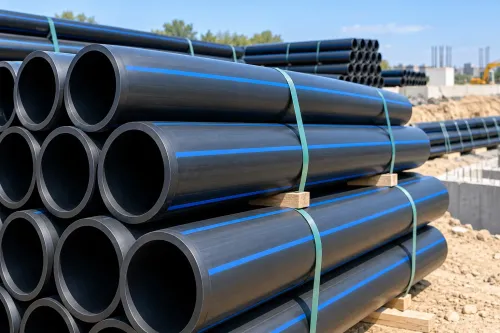
PLB generally means a pre-lubricated HDPE cable duct, in which a low-friction silicone or polymeric inner layer reduces resistance as a cable is pulled or blown through the bore.
The duct is a cable pathway, not a pressure-rated water pipe; an HDPE grade or IS 4984 water-pipe certificate alone does not prove cable-draw performance or railway acceptance.
A PLB duct normally has a tough outer HDPE wall, a smooth low-friction bore, and colour or stripe identification. The inner layer may be co-extruded with the wall or applied as a permanent lining, so inspect the cut end and request evidence that it remains continuous.
A plain HDPE duct has no comparable integrated friction-reducing layer.
| Construction | Cable-installation effect | What to verify |
|---|---|---|
| Plain HDPE duct | Cable friction depends on the unmodified bore and installation lubricant | Bore smoothness, pulling limits and lubricant compatibility |
| Pre-lubricated HDPE duct | Lower resistance supports pulling or blowing over longer routes | Inner-layer evidence, friction data and cable-sheath compatibility |
| Co-extruded PLB duct | Outer strength and inner low-friction performance come from separate layers | Layer adhesion, wall dimensions and ovality |
For a PLB duct pipe for railway signal telecom Nagpur project, request the governing Indian Railway, RDSO, zonal railway or project specification before accepting a generic datasheet. The same applies when comparing a PLB duct pipe Nagpur supplier or a product-search term such as “tatflow PLB duct pipe.”
How a railway signal duct carries cables along the route
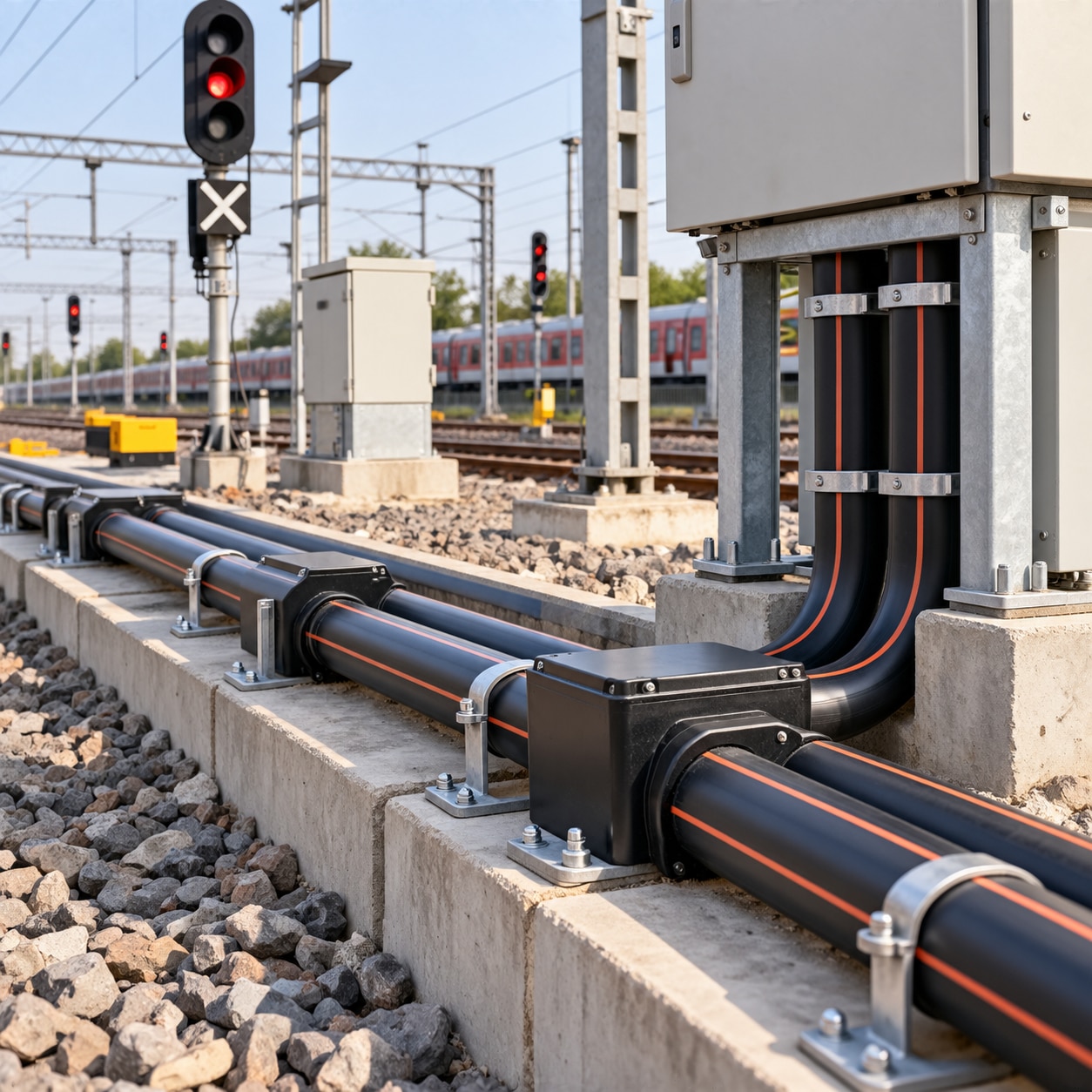
A railway signal duct pipe carries cables through a planned underground route; it does not operate the signalling system itself. The trench drawing fixes alignment, depth and crossing details, while access points determine where installers can pull, inspect or join cables.
Typical cable assignments are:
- Signalling cable for trackside signalling equipment.
- Fibre-optic communication cable for railway data links.
- Axle-counter cable connecting detection equipment.
- Power cable supplying trackside equipment.
- Trackside telecom cable for railway communications.
Install a draw rope through every duct and record its rated pulling strength at the entry point. Pull cables with the rope, or blow fibre where the duct and cable design permit. A missing rope, blocked bore or crushed section can turn a routine installation into excavation.
Keep power and communication circuits in separate ducts or follow the segregation shown on the railway design. Do not treat spare space as permission to mix circuits.
Use swept bends instead of sharp direction changes. Place access points where the approved route allows cable pulling and jointing, and seal unused duct ends against soil and water. A duct intended for open-trench installation is not automatically suitable for HDD; its pulling load and bend limits must match that route.
How to choose the correct PLB size and construction
Start with the cable schedule, not a nominal catalogue size. Measure each cable’s outside diameter, count the cables sharing the bore, and allow clearance for the pulling or blowing method. Common telecom sizes such as 32/26, 40/33 and 50/42 mm state outside/inside diameter; they do not prove suitability for a railway signal duct pipe.
Confirm wall thickness, stiffness, crushing resistance and any pressure requirement in the tender.
| Supply or construction | Verify | Why it matters |
|---|---|---|
| Coil | Coil length, ovality and minimum bend radius | Reduces joints, but poor handling can kink the bore |
| Straight length | Jointing method and available access points | Suits rigid routes, but adds joints and alignment work |
| Single-wall HDPE | Wall thickness and low-friction bore specification | Provides simpler construction, but may not meet draw-force limits |
| Co-extruded duct | Inner-layer adhesion and sheath compatibility | Controls friction without damaging the cable sheath |
For PLB duct pipe Nagpur procurement, put these checks in the purchase order:
- State maximum pulling tension, sidewall pressure at bends, and the minimum bend radius; exceeding any one can stretch the cable or collapse the duct.
- Specify the operating and storage temperature range, cable-sheath material, colour, marking and batch traceability.
- Name the governing railway or project specification and approval route. A water pipe conforming to IS 4984 is not evidence of cable-draw performance or railway acceptance.
What Nagpur and Maharashtra installation conditions change
Nagpur’s hot soil and intense monsoon change how you bed, drain and protect a PLB route. Use screened sand or fine selected soil around the duct, compact it in controlled layers, and provide drainage where water can collect; standing water can wash fines away and leave the duct unsupported.
In rocky ground, remove sharp stones or use a protective surround to prevent point loading and abrasion.
At road and track crossings, follow the approved depth and use a sleeve, concrete protection or another specified mechanical barrier. Ordinary trench cover may not withstand traffic, ballast impact or tamping. Keep access points at approved intervals and at bends, crossings and joint locations so blockages are recoverable without reopening the track.
- Store coils under shade, off the ground and away from UV exposure. In hot weather, let the duct cool before uncoiling, and prevent kinks, flattening and dragging.
- Inspect soil and construction materials for oil, solvents, fuels and pesticides. Confirm chemical compatibility before burial.
- Use clean, compatible couplers; keep joint faces dry and capped until assembly, then seal them against silt and monsoon water.
- Treat “plb duct pipe nagpur” and “telecom duct pipe in Maharashtra” as search terms, not material grades. Specify construction, dimensions, markings, storage limits and route-access requirements in the purchase order.
Which tests, documents and railway approvals to verify
Before purchase or installation, verify the contract’s cited Indian Railway, RDSO, zonal railway and project specification. A generic HDPE datasheet, or IS 4984 water-pipe compliance alone, does not prove cable-draw performance or railway acceptance.
| Evidence to request | What to check | Why it matters |
|---|---|---|
| Specification and approval | Named drawing, test standard, sample or first-article requirement, and approved-make status | Prevents acceptance disputes after installation |
| Material and testing | Material grade, carbon-black content and dispersion, tensile, impact, crush, ovality, wall thickness and environmental stress-crack results | “HDPE” alone is not a sufficient technical description |
| Traceability | Manufacturer’s test certificate, dimensional inspection report, batch number, coil identification and marking schedule | Links each delivered coil to its test record |
| Inner surface | Bore sample, construction description and friction or low-resistance evidence for the pre-lubricated layer | A smooth-looking bore does not prove reliable cable pulling |
| Installation information | Minimum bend radius, pulling limit, jointing method, draw-rope provision and storage instructions | Prevents damage during Nagpur trench, crossing and coil work |
For tatflow plb duct pipe, ask TATFLOW for the exact project approval rather than assuming the product name establishes acceptance. Confirm that the approved make, colour, OD/ID, coil length and inner-layer requirement match the purchase order for plb duct pipe for railway signal telecom nagpur.
A practical inspection and installation checklist
Do not approve a plb duct pipe nagpur purchase from a generic datasheet. Compare the supplier’s marked sample and datasheet with the route drawing, cable schedule and railway acceptance package before releasing material.
- Confirm OD and ID, colour, marking, coil length, material records, batch number and approved-make status.
- Match the specified minimum bend radius and maximum pulling tension to the installation plan; pre-lubrication does not excuse a blocked duct, sharp entry or excessive load.
- Require a mandrel proving test after installation, route cleaning before cable work, and a continuous draw rope or tape sized for the planned pull.
- Record coil identification against each installed chainage, and specify sealed, mechanically protected joints, crossings and duct ends.
- For a telecom duct pipe in Maharashtra, check the order names the governing railway, RDSO, zonal railway or project specification rather than relying on the search term.
| Decision point | Accept | Reject or clarify |
|---|---|---|
| Marked sample versus route drawing | Size, bends and crossings agree | Any unshown deviation |
| Datasheet versus cable schedule | Pulling limits and bore suit every cable | Cable count or tension is missing |
| Acceptance package | Tests, traceability and instructions are complete | No batch evidence or approval record |
| Installed duct | Mandrel passes and ends are protected | Obstruction, damaged joint or open end |
Frequently asked questions
What does PLB mean in railway signal ducting?
PLB generally means a pre-lubricated HDPE cable duct. Its low-friction inner layer helps reduce resistance when signal or telecom cables are pulled or blown through the bore.
How do you choose a PLB duct size for railway signals?
Choose the internal bore after counting the cables, checking each cable’s outside diameter and allowing space for installation, bending and future capacity. Confirm the result against the pulling or blowing method and route geometry.
Which Nagpur and Maharashtra conditions affect PLB duct installation?
Plan for hot ground, monsoon rainfall, saturated soil, road and track crossings, utility congestion and backfill quality. Protect the duct from sharp stones, standing water, excessive bending and damage during compaction.
What should you verify before accepting railway signal duct pipe?
Check the manufacturer’s test reports, material and batch identification, dimensional results, pressure or performance test details where specified, installation guidance and the railway project’s approved-vendor or technical-document requirements.
Keywords