
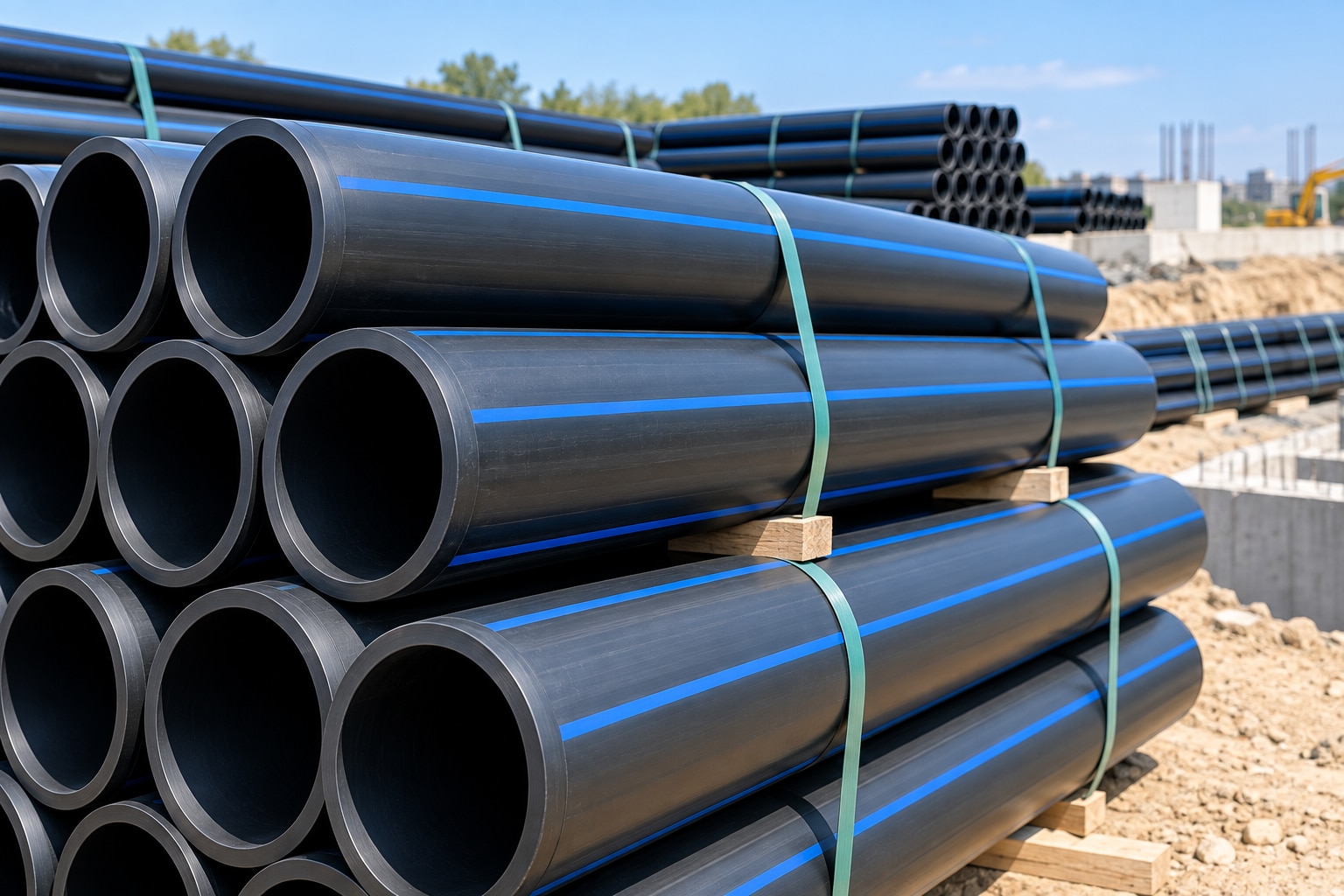
Choosing a pressure pipe for a Nagpur water project requires more than comparing HDPE prices. You need to match the pipe’s material class, SDR, pressure rating, hydraulic capacity, joining method and installation route, then verify that the supplier can document every production lot. By the end, you will have a practical checklist for evaluating a local manufacturer and comparing HDPE with other pipe materials.
Key takeaways
- Specify pressure-rated pipe to IS 4984:2016, not a cable duct.
- Choose PE63, PE80 or PE100 from pressure, temperature and hydraulics.
- Require fusion logs, inspection records and commissioning test results.
- Verify the supplier’s product ID, batch traceability and water-pipe documentation.
Start with the correct water-pipe specification and Indian standard
Specify a pressure-rated water pipe to IS 4984:2016, not a telecommunications duct or electrical conduit. Ask the hdpe water supply pipe supplier in nagpur to identify the catalogue product intended for water supply by its exact printed product ID and confirm that the ID is not a duct or non-pressure SKU.
Black polyethylene alone proves nothing: ducts can have different tolerances, resin controls, markings and acceptance tests.
- Put the exact product ID and IS 4984:2016 compliance in the enquiry.
- State the material designation: PE63, PE80 or PE100; nominal outside diameter; SDR; and PN rating or pressure class.
- Request the production batch or lot number, resin and compound identification, dimensional inspection results and hydrostatic test reports.
- Require a signed conformity certificate linking the supplied pipe to its batch, dimensions and stated pressure class.
- Ask whether the water-pipe range is manufactured at the stated facility, rather than accepting a generic catalogue description from a water infrastructure pipe supplier nagpur.
“HDPE pipe” is not a sufficient tender description because identical outside diameters can have different wall thicknesses, internal diameters and flow capacities. For potable water, add separate requirements for permitted composition and recycled content, extraction or taste-and-odour performance where the authority requires it, cleaning, disinfection, flushing and post-installation water-quality testing.
Pressure compliance alone does not establish drinking-water acceptance.
Select PE63, PE80 or PE100 from pressure, temperature and hydraulics
PE100 is not an automatic answer. Select PE63, PE80 or PE100 only after checking sustained operating pressure, design temperature, diameter, burial loads, groundwater, traffic loading and the project’s design life. A flexible pipe still needs a transient analysis: model pump starts and stops, power failure, rapid valve closure, air release and column separation.
Surge can exceed the nominal PN rating, while vacuum can cause buckling.
| Material class | Pressure-design implication | Selection check |
|---|---|---|
| PE63 | Lower long-term strength designation | Use only where calculated pressure, temperature and life remain within its allowable stress |
| PE80 | Intermediate long-term strength designation | Compare its required wall thickness and cost with PE100 for the same duty |
| PE100 | Higher long-term strength designation, not an automatic higher-pressure pipe | Confirm SDR, temperature derating, design coefficient and transient pressures |
Specify the pipe by nominal outside diameter and SDR. Wall thickness is approximately outside diameter divided by SDR, so a smaller SDR gives a thicker wall and higher pressure capacity; two pipes with the same outside diameter can have different internal diameters.
For PE100, the 10 MPa minimum required strength designation is commonly divided by a 1.25 design coefficient to obtain about 8 MPa design stress before calculating pressure capacity. Check the design life and ISO 9080 long-term hydrostatic-strength assumption.
For an hdpe pipe for water supply nagpur project, calculate flow using actual internal diameter, fittings, fusion-bead allowances where relevant, aging, velocity and allowable head loss. Treat PN 10 or PN 16 as nominal ratings, not a complete transient design.
Compare HDPE with ductile iron, PVC, steel and concrete for the route
HDPE is the practical choice for a flexible, corrosion-free main that must move quickly through open-cut, HDD or river-crossing work. For anyone comparing an hdpe pipe supplier in maharashtra, compare the route and repair plan, not only pressure class or price per metre.
| Material | Pressure and corrosion | Flexibility, joints and installation | Weight, repair and maintenance |
|---|---|---|---|
| HDPE | Pressure depends on SDR, temperature and design stress; does not rust | Flexible fused joints; fast installation and excellent HDD suitability | Light; repair by cutting and electrofusion or mechanical coupling; low corrosion maintenance |
| Ductile iron | High pressure capacity; needs corrosion protection in aggressive soil or water | Rigid push-on or restrained joints; slower handling and trench work | Heavy; replace damaged sections or use repair couplings; coating and corrosion inspections add work |
| PVC or uPVC | Efficient pressure service; vulnerable to impact, brittle fracture and temperature limits | Light, rigid lengths with solvent, gasketed or restrained joints; quick open-cut installation | Light; repair with couplings and replacement; joint and bedding quality control remain important |
| Steel | Very high pressure and structural capacity; external and internal corrosion require protection | Flexible in design but welded or mechanically joined; fabrication slows work | Heavy; coating repairs and welding equipment increase maintenance |
| Concrete | Suits large-diameter, lower-pressure or gravity systems | Rigid, heavy and unsuited to tight bends or routine HDD | Very heavy; sectional replacement is difficult; monitor cracking, joints and corrosion |
For a hdpe pipe for water supply nagpur route assessment, require these checks before approving HDD:
- Calculate allowable pullback force, tensile stress, minimum bend radius, drilling-fluid buoyancy, entry and exit geometry, pullback duration and point-loading protection; long-term creep, not short-term yield strength, governs allowable pull.
- For open cuts and river crossings, control groundwater, buoyancy and restraint at valves, tees, reducers and rigid transitions.
- At road or railway crossings, specify the pressure pipe, casing or protection arrangement and authority approval separately; cable-duct assumptions do not establish water-main compliance.
Control fusion joints, trench support and commissioning records
A sound fusion joint starts with a qualified process, not a neat-looking bead. Butt fusion requires clean, square faces, controlled heater temperature, alignment, joining pressure and uninterrupted cooling. Electrofusion requires scraping where specified, correct insertion depth, stable clamping and uninterrupted power through the fusion cycle.
Use trained operators and calibrated equipment for both methods; do not treat them as interchangeable site details.
The quality file for a water infrastructure pipe supplier nagpur project should contain:
- Operator credentials and machine calibration records
- Fusion parameters, joint numbers and pipe-batch traceability
- Visual inspection results and acceptance criteria
- Nonconformance reports, repairs and disposition
- Representative destructive bend or tensile testing when project risk warrants it
Support the pipe continuously on suitable bedding, then compact side support before placing the main backfill. Confirm the specified minimum cover, allowable bend radius and protection at valves, tees and transitions to rigid pipe.
Dewater the trench or control groundwater, because an empty HDPE pipe can float; use temporary filling, ballast or restraint where buoyancy threatens alignment. Install warning tape and marker posts, and define separate protection for road and railway crossings rather than borrowing cable-duct assumptions. Place backfill in controlled layers and verify compaction.
Commissioning must follow the project specification: pressure-test the installed section, flush it, disinfect potable-water lines and complete post-installation water-quality tests where required. Passing a visual joint inspection alone does not prove pressure integrity, cleanliness or safe drinking water.
Evaluate the Nagpur supplier beyond catalogue claims
Before signing a project order, match the quotation to the exact catalogue product ID for pressure water service, not a black HDPE duct. Confirm that the HDPE water pipe manufacturer Hingna listing names the Hingna, Nagpur facility as the manufacturing location for that product range.
Request these records for the quoted lot:
- Resin and compound identification, including PE63, PE80 or PE100 designation
- MFR or melt-flow verification and carbon-black or UV-stabilisation evidence where applicable
- Nominal outside diameter, wall thickness, SDR and PN markings
- Dimensional inspection results, hydrostatic test results and calibration records
- Pipe-length-to-lot traceability, batch numbers and a clearly identified test-report format
- Available diameters, plus straight or coiled lengths, coil diameter, ovality limits and handling requirements
| Check | Accept | Stop and verify |
|---|---|---|
| Catalogue identity | Pressure-service product ID and IS 4984:2016 reference | “HDPE pipe” with no water-pipe designation |
| Manufacturing origin | Hingna, Nagpur facility named for the quoted range | Distributor-only paperwork |
| Marking | Diameter, SDR, PN, material grade and lot number | Missing or inconsistent markings |
| Supply format | Lengths fit transport, access, bending-radius and fusion plans | Coil offered without handling or joint assessment |
Compare delivered cost, not only rupees per metre. Include fusion-joint count, transport, unloading, storage, handling equipment, site access, testing, repair response and lead time. TATFLOW’s local production documentation can support this comparison, but it does not replace engineering approval or conformity review.
Frequently asked questions
Which Indian standard applies to HDPE water supply pipes?
Specify pressure-rated polyethylene pipes manufactured for water supply to IS 4984:2016. Confirm the product ID identifies a water pipe rather than a telecommunications duct or electrical conduit.
How do you choose between PE63, PE80 and PE100?
Compare the required operating pressure, water temperature, pipe diameter, wall thickness and hydraulic performance. Select the grade that meets the design pressure and service conditions with the required safety margin.
How does HDPE compare with ductile iron, PVC, steel and concrete pipe?
Compare each material for pressure rating, corrosion exposure, jointing method, route flexibility, installation equipment, hydraulic roughness, trench conditions and maintenance access.
What records should you require for HDPE water-pipe installation?
Request product identification, batch traceability, fusion-joint logs, operator details, weather and heating records, trench inspection notes, pressure-test results and commissioning documentation.
How can you evaluate an HDPE water pipe supplier in Nagpur?
Ask for the exact printed water-pipe product ID, IS 4984:2016 documentation, batch records, quality-test reports, dimensional data and evidence that the manufacturer can support your project’s fusion and delivery requirements.
Keywords